
7 Best Lead Nurture Software for Law Firms (2026) Compared

TL;DR
The average law firm takes 42 hours to respond to a web form, and 79% of legal consumers hire the first attorney who responds helpfully. Lead nurture software closes that gap by automating follow-up across phone, email, SMS, and chat. This guide compares seven tools built for (or adapted to) law firms, covering real pricing, integration details, honest tradeoffs, and the shift from email-only drip campaigns to multi-channel, phone-first nurture strategies that actually convert leads into signed retainers.
Why Most Law Firms Don’t Need More Leads
They need to stop losing the ones they already have.
According to the ABA Tech Report 2025, only 23% of law firms use dedicated lead management software. The rest rely on sticky notes, spreadsheets, and good intentions. The result is predictable: the average firm converts just 14% of inquiries into signed clients, while top performers hit 40 to 50%.
The numbers get worse when you look at response times. Clio’s 2025 Legal Trends Report found that the average law firm takes one to three business days to respond to new inquiries. Only 8% respond within one hour. Meanwhile, Hennessey Digital’s study of nearly 1,400 law firms revealed that 27% never responded to online lead form submissions at all.
This isn’t a lead generation problem. It’s a lead nurture problem.
Lead nurture software for law firms automates the follow-up process from first contact through signed retainer. The best tools handle phone calls, SMS, email, and chat in coordinated sequences, qualifying prospects and booking consultations without waiting for a human to check their inbox Monday morning.
Below are seven tools worth evaluating, starting with the only platform that combines AI voice reception, outbound dialing, and case management automation in a single legal-specific suite.
Book a personalized demo to see how AI-powered lead nurture works for your practice area.
At-a-Glance Comparison Table
| Tool | Starting Price | Best For | Legal-Specific | Outbound Dialer | AI Voice | Key PMS Integrations |
|---|---|---|---|---|---|---|
| Lawtté Scale | $499/mo | Full-funnel AI nurture (phone + chat + SMS) | Yes, deep | Yes, 100+ calls/hr | Yes, 24/7 | Clio, Filevine, MyCase, CasePeer, +5 |
| Lawmatics | $199/mo | Email/text automation depth | Yes | No | No | Clio, Filevine, PracticePanther, +3 |
| Clio Grow | $59/user/mo | Firms already on Clio Manage | Yes | No | No | Clio Manage (native) |
| Lead Docket | $300/mo | Filevine-based PI firms | Yes | No | No | Filevine (native) |
| Law Ruler | $199/mo (3 users) | High-volume PI/mass tort intake | Yes | Yes, basic | No | CosmoLex, Tabs3, Rocket Matter |
| GoHighLevel | $97/mo | Budget DIY automation | No, generic | No | No | Via Zapier only |
| HubSpot | Free / $15/seat | Inbound marketing focus | No, generic | No | No | Clio, LawPay via marketplace |
What to Look for in Lead Nurture Software
Before diving into individual tools, here’s what separates useful lead nurture software from expensive shelf-ware.
Speed-to-Lead Automation
You’re 21 times more likely to qualify a lead if you respond within five minutes, according to Lead Response Management research. Firms that respond within 60 seconds see a 391% boost in conversion rates compared to those responding at the 30-minute mark. Your software needs to make sub-five-minute response times automatic, not aspirational.
Multi-Channel Follow-Up
Email drip campaigns are table stakes. The firms winning right now combine phone, SMS, email, and chat into coordinated sequences. If a prospect fills out a form at 9 PM, the software should call them, text them, or chat with them immediately, not queue an email for the morning. For firms handling after-hours calls, an AI virtual receptionist can bridge the gap between submission and human follow-up.
Legal PMS Integration
If your lead nurture software doesn’t sync with Clio, Filevine, MyCase, or CasePeer, you’re signing up for double data entry. Native integrations matter more than Zapier workarounds, especially for intake-to-matter handoffs where missing a field can delay case opening.
Lead Qualification and Scoring
Not every inquiry deserves attorney time. The software should screen for practice area fit, case viability, and urgency before routing to an attorney. This is where AI-powered intake has started to outperform manual processes, applying consistent screening questions every time.
Compliance
TCPA compliance for outbound calling and texting isn’t optional. Data encryption matters for client confidentiality. Bar rules in your jurisdiction may impose additional requirements around solicitation and advertising.
After-Hours Coverage
Criminal defense inquiries, personal injury accidents, and immigration emergencies don’t wait for business hours. As one practitioner noted on Xprts: “If your firm is one of 10 that a potential client contacts at 9pm, and your firm is the only one with an automated response, you’ll likely be the only firm that gets a response back.”
The 7 Best Lead Nurture Software Tools for Law Firms
1. Lawtté Scale
Best for: Full-funnel AI lead nurture combining phone, chat, and SMS in one legal-specific platform
Editor’s Pick
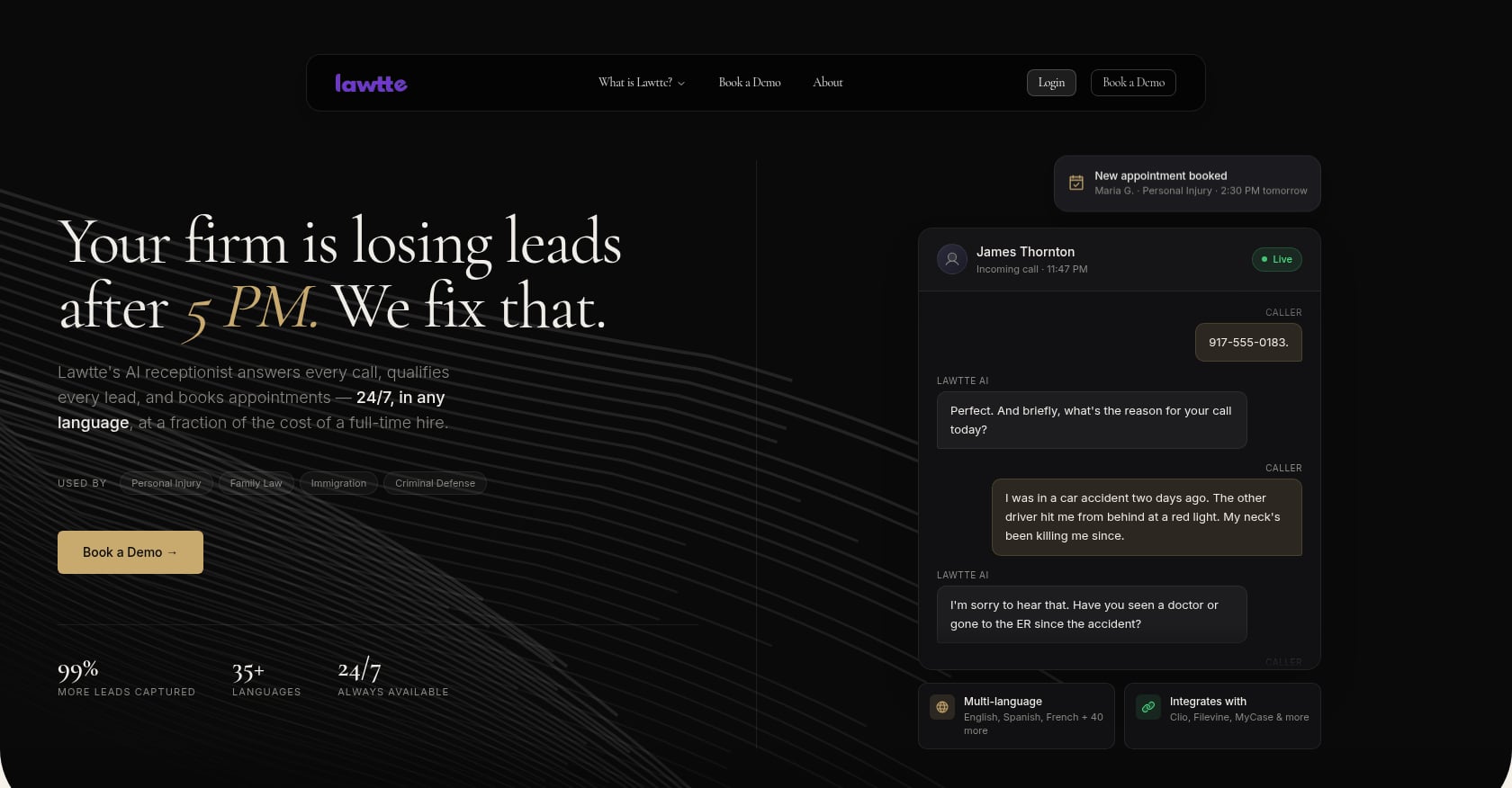
Lawtté Scale is the outbound lead management module within Lawtté’s three-product suite (Concierge for AI reception, Link for case management automation, and Scale for lead nurture). It’s the only tool on this list that handles AI voice reception, outbound dialing, and multi-channel nurture sequences from a single platform built specifically for law firms.
Pricing:
- Scale starts at $499/mo for 205 outbound calls/month (roughly 410 minutes)
- Overages: $0.80/min
- Bundle two products for 10% off, all three for 15% off
- Annual billing saves 20%
- 14-day money-back guarantee
Key Features:
- Outbound dialer at 100+ calls per hour, TCPA-compliant
- Welcome-to-close nurture sequences across phone, chat, and SMS
- Retargeting and lead re-engagement campaigns
- PI-specific auto-dialer for DEC letters and medical record chases
- 10+ language support with automatic language recognition
- Integrations with Clio, Filevine, MyCase, CasePeer, Lawmatics, PracticePanther, Litify, and HubSpot
- 37 REST API endpoints for custom automations
Real User Perspective:
On-site testimonials report a 45% increase in qualified leads and a 38% conversion lift. Artificial Lawyer featured a product walkthrough in January 2025, noting the system’s natural responses and live language switching during intake calls.
Tradeoffs:
- AI voice may need escalation for complex edge cases or emotionally charged callers
- No public SOC 2 attestation listed (security posture is marketed but formal certifications aren’t shown)
- At $499/mo, the starting price is higher than email-only CRM tools, though it covers capabilities that would otherwise require multiple subscriptions
Verdict: The strongest option for firms that want phone-based lead nurture, not just email sequences. Particularly well suited for personal injury firms with high inbound volume and immigration practices that need multilingual coverage.
Explore the complete intake solution to see how Concierge, Link, and Scale work together.
2. Lawmatics
Best for: Deep email and text marketing automation for growth-focused firms
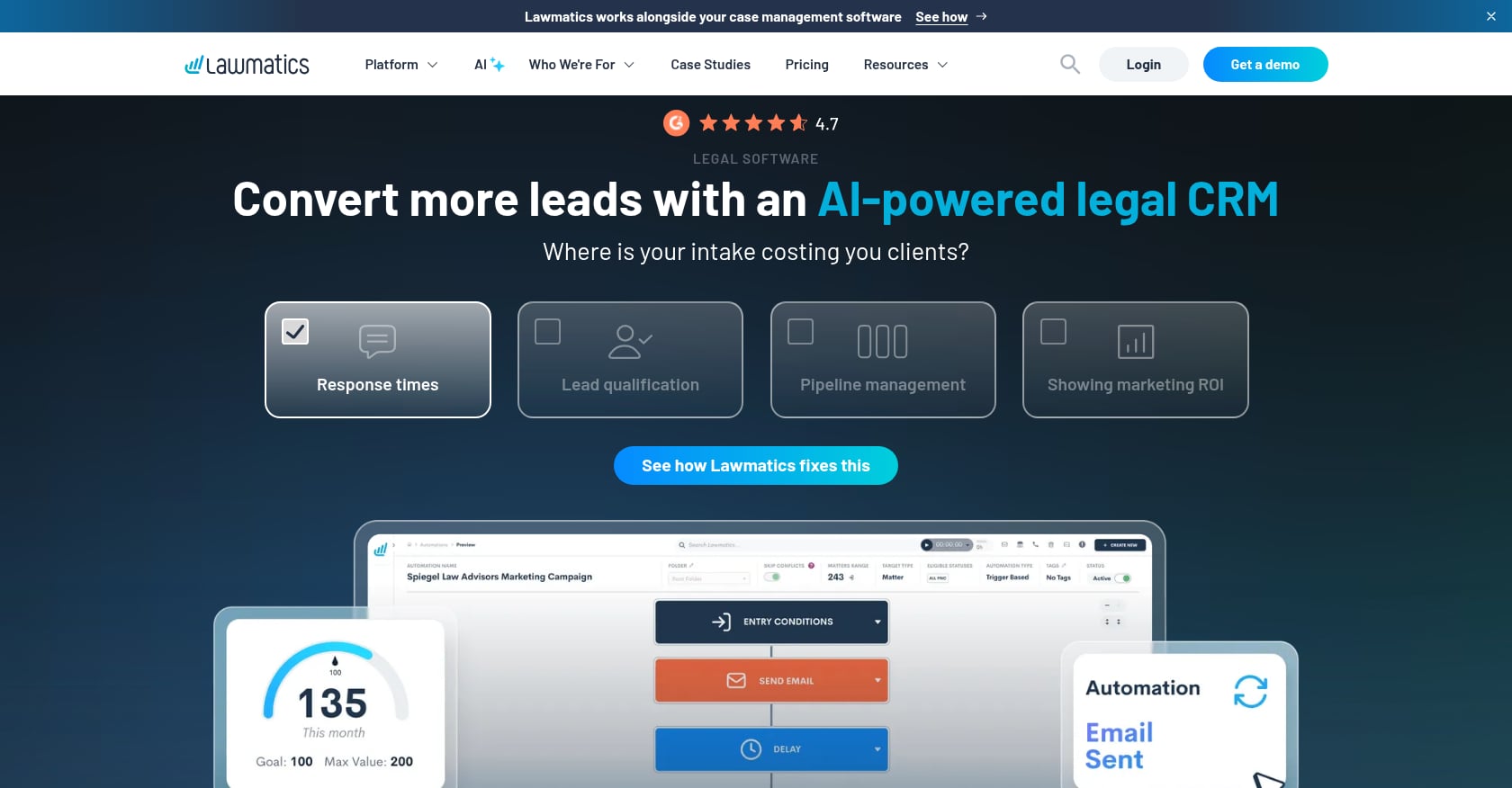
Lawmatics is the most popular legal-specific marketing automation platform, and it earns that reputation with genuinely sophisticated workflow capabilities. If your nurture strategy is primarily email and text-based, it offers more customization depth than most competitors.
Pricing:
- Lite plan: $199/mo (limited automations)
- Pro plan: $299/mo
- Per-firm pricing, not per-user (a significant advantage at scale)
- 3-user minimum
- Implementation takes 2 to 6 months depending on firm complexity
Key Features:
- Complex follow-up sequences via email and text messaging
- Custom form builders with conditional logic
- Detailed ROI and source reporting
- Workflow automation triggered by practice area, lead source, or prospect behavior
- Integrations with Clio, Filevine, and PracticePanther
Real User Perspective:
A reviewer on Software Advice captured the common experience: “With so many bells and whistles and options, it can be daunting. If you have no CRM background and are unsure how your workflow and automations should look, that can be scary.” Another added: “It can be a struggle to learn, and to make automations that truly work well. We had a third-party vendor set ours up but it never really worked as we want it to.” On the positive side, one user on the same platform wrote: “Overall, I do love Lawmatics. Just wish they expanded on the Lead Management and concentrated on that rather than trying to become a one stop shop for law firms.”
Tradeoffs:
- Steep learning curve, especially without CRM experience
- No outbound dialer or AI voice component
- Implementation timeline of 2 to 6 months means slow time-to-value
- Feature creep may be diluting core lead management quality, per user feedback
Verdict: The best email/text automation tool for legal, but it won’t answer your phone at midnight or dial 100 prospects per hour.
3. Clio Grow
Best for: Firms already using Clio Manage that want integrated intake
Clio Grow is the intake and CRM module that pairs with Clio Manage, the most widely used practice management system in small to mid-size firms. If you’re already paying for Clio Manage, Grow adds lead tracking, online scheduling, intake forms, and e-signatures with zero integration headaches.
Pricing:
- Standalone: $59/user/mo (annual) or $69/user/mo (monthly)
- Clio Complete bundle (Manage + Grow): $149/user/mo
- Per-user pricing applies to every user
Key Features:
- Lead tracking and pipeline management
- Online scheduling and intake forms
- E-signature capability
- Automatic data transfer when prospects become clients in Clio Manage
- Native integration eliminates duplicate data entry
Real User Perspective:
Small firms on Clio appreciate that intake information flows directly into case files without re-entry. The consistent complaint, however, is cost at scale. A 5-attorney PI firm typically spends $1,500 to $2,500+ per month across Clio Manage, Grow, third-party integrations, and per-document fees.
Tradeoffs:
- Per-user pricing compounds quickly as firms grow (10 users on Complete = $1,490/mo)
- Limited marketing automation compared to Lawmatics
- No outbound dialer or AI voice
- Locks you deeper into the Clio ecosystem
Verdict: The path of least resistance for Clio shops, but the per-user model punishes growth, and lead nurture capabilities are relatively basic.
4. Lead Docket
Best for: Filevine-based PI firms wanting streamlined lead-to-case handoff
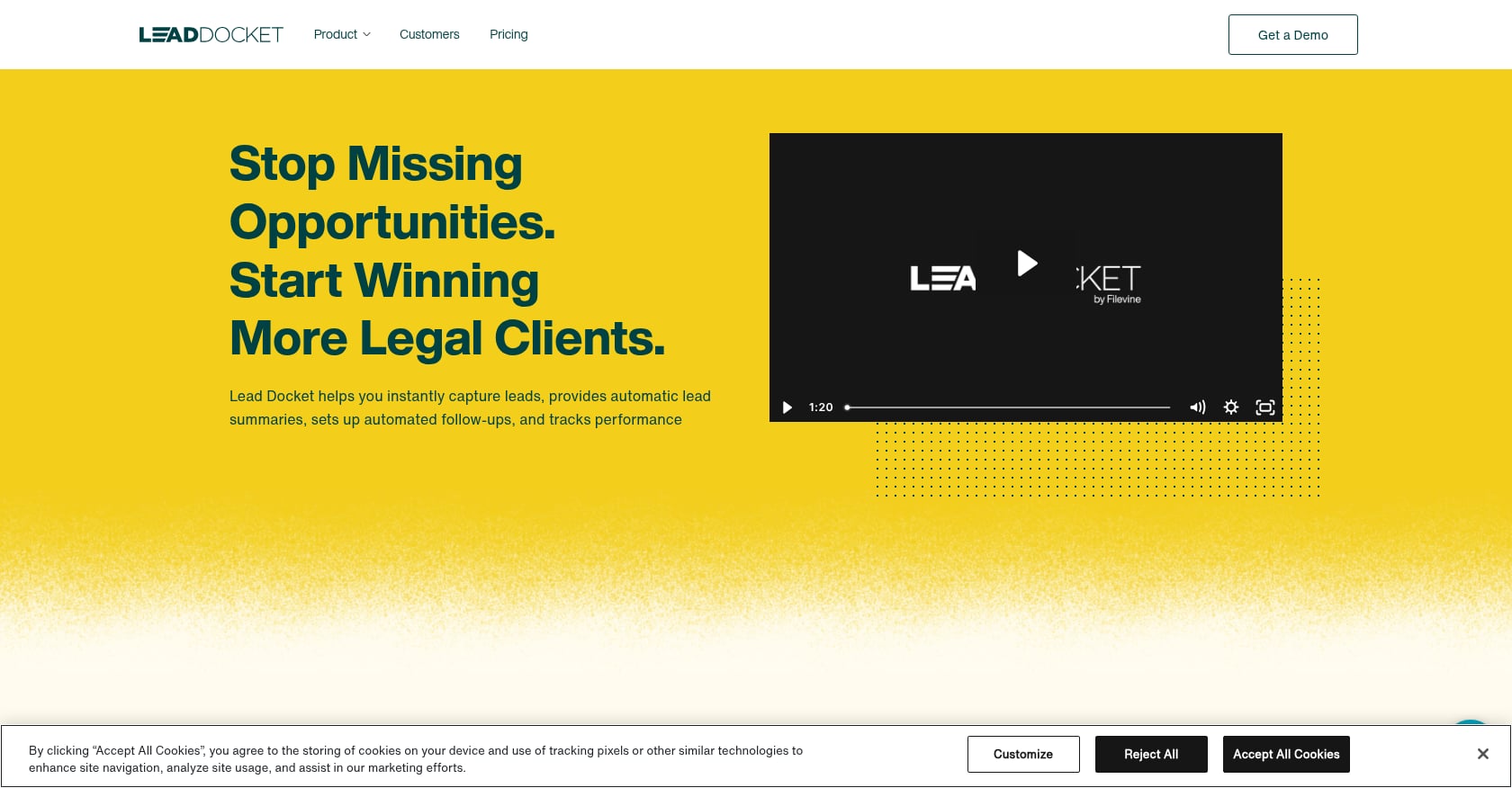
Lead Docket (now owned by Filevine) is a focused lead management tool that prioritizes simplicity over feature sprawl. Its LeadsAI feature summarizes lead details, messages, and notes so intake staff can prioritize high-potential clients quickly.
Pricing:
- Starts at $300/mo
- Custom quotes based on firm size
- Per-firm pricing
Key Features:
- LeadsAI for lead summarization and prioritization
- Native data transfer to Filevine (unified client record, no double entry)
- Lead source tracking and attribution
- Simple, fast onboarding (days, not months)
Real User Perspective:
A Capterra reviewer noted: “As with other legal software, it does take some time to get used to and isn’t super intuitive. It is bare bones in its appearance.” But the simplicity cuts both ways: “The platform’s simplicity is its greatest strength. Your team can start using it effectively within days, not months.”
Tradeoffs:
- Reporting has limitations per user reviews
- No mobile app
- English-only (no multilingual support)
- No outbound dialer
- Value drops significantly if you’re not on Filevine
Verdict: If your firm runs on Filevine and you need clean lead-to-case flow, Lead Docket is the obvious choice. For firms needing multilingual intake support or outbound nurture, look elsewhere.
5. Law Ruler
Best for: High-volume PI and mass tort intake operations
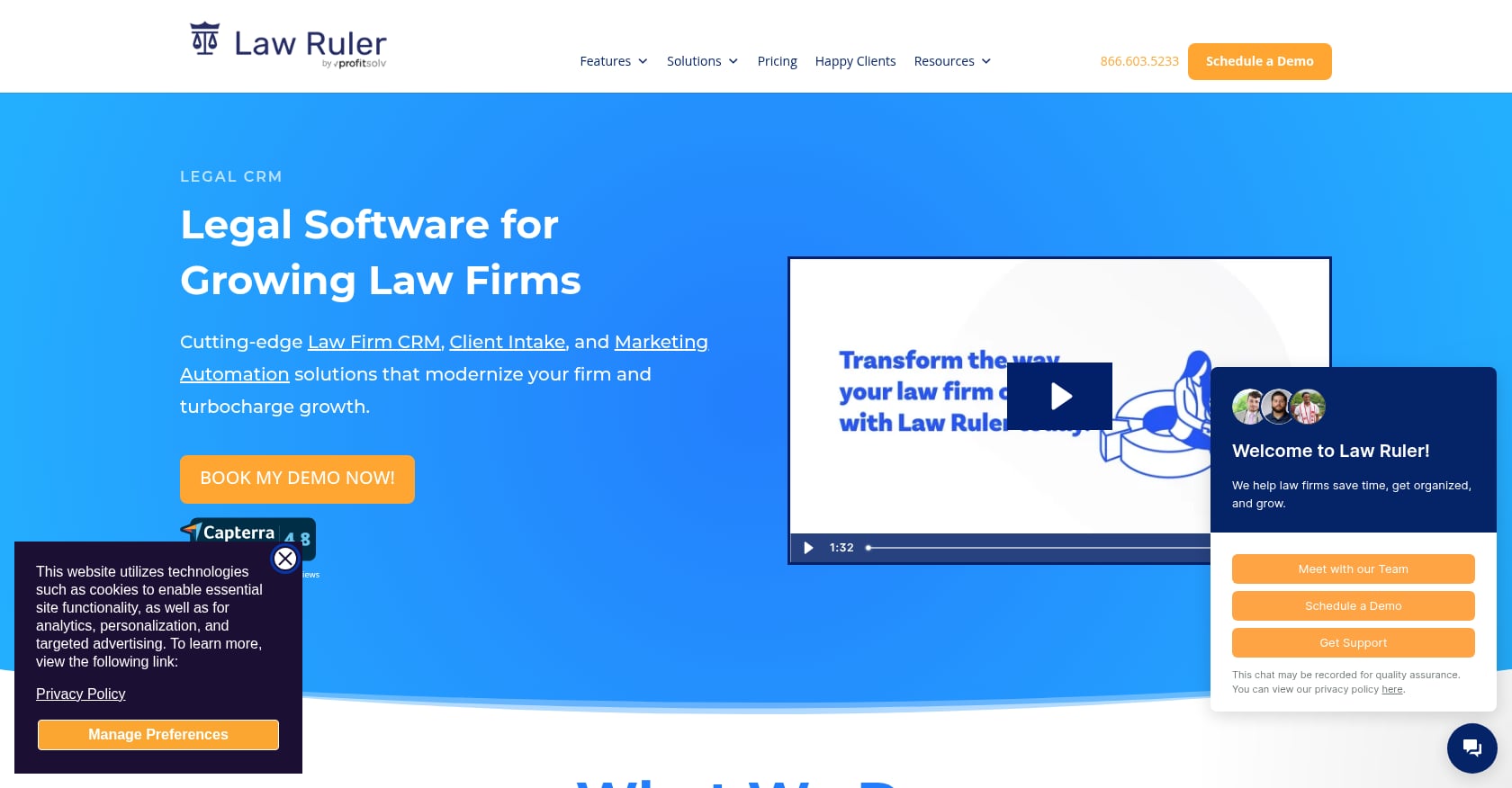
Law Ruler targets firms that process hundreds or thousands of leads monthly. It includes a built-in softphone dialer, automated email/text campaigns, and one-click e-signatures, making it a solid all-in-one for intake-heavy practices.
Pricing:
- Pro plan: $199/mo for 3 users, 10,000 contacts
- Premium plan: $249/mo for 15,000 contacts
- Additional 5,000 contacts: $21/mo
- One-time onboarding fee: $399
Key Features:
- Intelligent intake form builder
- Automated email, text, and voice calling campaigns
- Built-in softphone dialer
- One-click e-signature and document automation
- Lead source tracking
Real User Perspective:
A G2 reviewer wrote: “Law Ruler does all the legal CRM basics well, and it offers more advanced features like document management, lead management, and text messaging for a reasonable price.” The primary complaint: “No messaging within the software. You have to use a workaround to message colleagues within the software.”
Tradeoffs:
- Integration ecosystem is narrower (primarily ProfitSolv family: CosmoLex, Tabs3, Rocket Matter)
- Contact-based pricing adds up for high-volume firms ($21 per 5,000 contacts)
- $399 onboarding fee on top of monthly subscription
- Dialer is basic compared to Scale’s 100+ calls/hour capability
Verdict: Strong for PI and mass tort firms that need voice capabilities at a lower price point, though the dialer and automation depth trail more specialized tools.
6. GoHighLevel
Best for: Tech-savvy firms (or firms with a GHL agency) wanting maximum customization at minimum cost
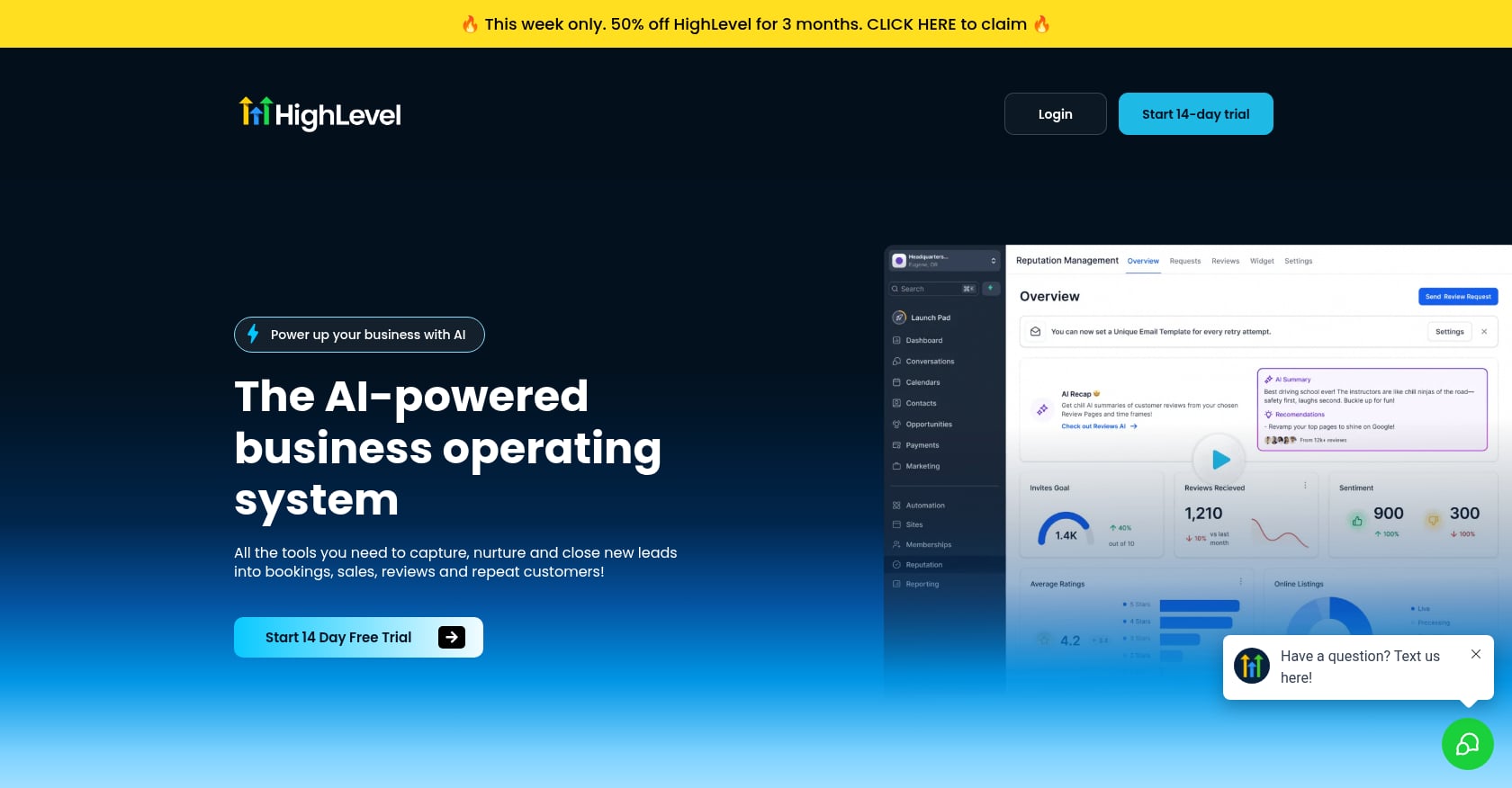
GoHighLevel is the Swiss Army knife of marketing automation. It packs funnels, landing pages, forms, calendars, email, SMS, call tracking, and nurture workflows into one platform at a fraction of what legal-specific tools charge. The catch: none of it is configured for legal practice out of the box.
Pricing:
- Starter: $97/mo
- Unlimited: $297/mo
- 14-day free trial
Key Features:
- Funnels, landing pages, and forms
- Email and SMS nurture sequences
- Call tracking and attribution
- Calendar booking
- White-label capability (popular with legal marketing agencies)
Real User Perspective:
An analysis from Modern Law Association, drawing on experience with 1,400+ law firms, captured the core problem: “GoHighLevel delivers tremendous raw capability, yet most law firms struggle to configure it properly for legal practice.” They added: “The workflows that ship with GoHighLevel assume business models unlike legal practice. A law firm cannot simply activate a ‘lead nurture sequence’ designed for a roofing company.”
Tradeoffs:
- Not legal-specific. Every workflow needs manual reconfiguration for legal contexts
- Integrations with Clio, MyCase, and PracticePanther require significant technical work; bidirectional sync rarely works out of the box
- Heavy setup burden means most firms need a consultant or agency
- No AI voice, no legal intake qualification
- Compliance configuration (TCPA, bar rules) falls entirely on the firm
Verdict: The cheapest option with the highest hidden cost. Only worthwhile if you have a technical team or agency partner who already knows both GHL and legal workflows.
7. HubSpot

Best for: Firms prioritizing inbound content marketing and general CRM functionality
HubSpot is the 800-pound gorilla of marketing automation. Its free CRM tier is genuinely useful for basic contact management, and its marketing tools are world-class for content-driven lead generation. For law firms, though, it requires significant customization and bolt-on subscriptions to function as lead nurture software.
Pricing:
- Free CRM tier
- Marketing Hub Starter: $15/seat/mo
- Marketing Hub Professional: $890/mo for 3 seats
- Meaningful automation requires Professional tier
Key Features:
- Email campaigns and marketing automation
- Landing pages and blog tools
- Lead scoring and nurture workflows
- Legal tool integrations: Clio, LawPay, TimeSolv, DocuSign via marketplace
- Extensive reporting and analytics
Real User Perspective:
Practitioners consistently note the same tradeoff: the free tier hooks you in, but meaningful automation requires Professional at $890/mo plus onboarding fees. Per-user costs escalate quickly beyond the initial three seats.
Tradeoffs:
- No native legal billing, trust accounting, or intake-specific workflows
- Not legal-specific; requires configuration for every legal workflow
- Enterprise pricing is steep for firms that outgrow Starter
- No outbound dialer or AI voice
Verdict: Excellent for firms investing heavily in content marketing and inbound lead generation. Not the right tool if your primary need is intake automation or phone-based nurture.
Why Phone-Based Lead Nurture Matters More Than Email Drips
Every tool on this list except Lawtté Scale and Law Ruler treats lead nurture as an email and text workflow. That’s a problem, because the data tells a different story about where conversions actually happen.
Combining missed call volume with case values, the average multi-attorney firm loses $200,000+ annually to unanswered calls. A Thomson Reuters analysis found that a mid-size firm with 100 monthly leads losing 30% of conversions due to slow response is forfeiting approximately $450,000 to $1.2 million in annual revenue.
The gap is stark: 79% of legal consumers hire the first attorney who responds helpfully. Not the most experienced. Not the cheapest. The first one who picks up the phone and sounds like they care.
Email drip campaigns can’t replicate that. A well-timed email might keep your firm top of mind, but it won’t qualify a prospect, answer their questions about the process, or book a consultation at 10 PM on a Saturday when they’re sitting in an emergency room wondering if they have a case.
Practitioners on LawBrokr raise a valid counterpoint: “Most firms chase speed-to-lead, but fast responses to low-quality inquiries waste time and money. Pre-qualified leads convert better.” This is exactly right, and it’s why the best phone-based nurture tools combine speed with qualification. An AI intake system that answers in seconds and screens for case viability solves both problems simultaneously.
The firms hitting 40 to 50% conversion rates aren’t just fast. They’re fast and smart, responding immediately with relevant questions that separate viable cases from tire-kickers before an attorney ever gets involved.
How to Evaluate Lead Nurture Software for Your Firm
Match the Tool to Your Size and Practice Area
A solo family law attorney doesn’t need a 100-call-per-hour outbound dialer. A 20-attorney PI firm doesn’t need a free CRM tier. Match the tool to your actual workflow:
- Solo to 5 attorneys, single practice area: Clio Grow or Lawmatics Lite
- 5 to 20 attorneys, PI/mass tort focus: Lawtté Scale, Law Ruler, or Lead Docket
- High-volume, multi-practice firms: Lawtté Scale (for phone-based nurture) combined with Lawmatics or HubSpot (for email marketing)
- Budget-constrained but tech-savvy: GoHighLevel with an experienced agency
Run a Hidden Cost Audit
The sticker price is never the full cost. Check for:
- Onboarding fees: Law Ruler charges $399 upfront. HubSpot Professional onboarding starts at $750.
- Per-user scaling: Clio Grow at $149/user on the Complete plan means 10 users cost $1,490/mo.
- Per-contact charges: Law Ruler charges $21 per additional 5,000 contacts.
- Integration maintenance: GoHighLevel’s Zapier-based integrations break and need monitoring.
- Overage charges: Lawtté Scale overages are $0.80/min, which is transparent but worth budgeting for if your call volume spikes.
Check Your Integration Requirements
Before signing anything, confirm your lead nurture software connects to your practice management system with native, bidirectional sync. Zapier connections are better than nothing, but they add latency, fail silently, and create data gaps that only show up when a client falls through the cracks.
Start With a Trial or Demo
Most tools on this list offer some form of trial or demo period. Use it to test the specific workflows that matter to your firm: after-hours call handling, intake form completion, lead-to-matter handoff, and reporting accuracy.
Book a 30-minute demo to see Lawtté Scale in action with your practice area’s intake workflow.
Frequently Asked Questions
What is lead nurture software?
Lead nurture software automates the follow-up process between a prospect’s first contact with your firm and the point where they sign a retainer. It typically includes email sequences, SMS messaging, call automation, lead scoring, and integration with your practice management system. For law firms, it bridges the gap between marketing (generating leads) and intake (converting them into clients).
How much does lead nurture software cost for law firms?
Prices range from free (HubSpot’s basic CRM tier) to $499/mo or more for full-featured platforms. Email-focused tools like Lawmatics start at $199/mo. Per-user pricing (Clio Grow at $59 to $149/user) compounds with team size. Budget options like GoHighLevel start at $97/mo but require significant setup investment. Factor in onboarding fees, per-contact charges, and integration costs for a true total cost of ownership.
Can AI handle legal lead nurture as well as a human?
For initial response, qualification, and booking, AI consistently outperforms human staff on speed and availability. It answers at 2 AM, never forgets a screening question, and handles multiple calls simultaneously. The tradeoff is that complex emotional conversations (a distraught accident victim, a contentious custody situation) sometimes benefit from human warmth. The best approach is AI for first contact and qualification, with intelligent escalation to a human when the situation demands it. Firms exploring this model can learn more about AI answering services for legal practice.
What’s the best lead nurture software for personal injury firms?
PI firms have unique needs: high call volume, after-hours inquiries (accidents don’t happen 9 to 5), DEC letter and medical record chasing, and mass tort campaign management. Lawtté Scale and Law Ruler are the strongest options for PI-specific workflows. Lead Docket works well for Filevine-based PI firms that prioritize simplicity. The deciding factor is usually whether you need outbound dialing capability or primarily inbound intake management.
How do I integrate lead nurture software with Clio, Filevine, or MyCase?
Look for native integrations first. Clio Grow connects natively with Clio Manage. Lead Docket connects natively with Filevine. Lawtté offers integrations with Clio, Filevine, MyCase, CasePeer, and several other platforms. For tools without native connections (like GoHighLevel), you’ll need Zapier or custom API work, which adds cost and maintenance burden.
What’s the difference between a CRM and lead nurture software?
A CRM (customer relationship management) system stores contact information and tracks interactions. Lead nurture software actively automates outreach, follow-up sequences, and qualification workflows. Many tools blur the line, Lawmatics and HubSpot are both CRM and nurture platforms. The key distinction is whether the tool passively records data or actively moves prospects toward a consultation booking.
How quickly should my firm respond to new leads?
Within five minutes. Research shows you’re 21 times more likely to qualify a lead at the five-minute mark versus 30 minutes. Firms responding within 60 seconds see conversion rates nearly four times higher than those responding at 30 minutes. Given that only 8% of firms respond within one hour, hitting the five-minute window is a massive competitive advantage.
Is lead nurture software worth the investment for solo practitioners?
Yes, but calibrate the tool to your size. A solo practitioner doesn’t need a $499/mo outbound dialer. Clio Grow at $59/mo or HubSpot’s free CRM tier provides basic lead tracking and follow-up automation. The ROI case is simple: if you’re missing even two to three viable consultations per month due to slow follow-up, any lead nurture tool pays for itself. Most firms see positive ROI within three to six months through improved response times alone.
Bring Lawtté to your firm.
Walk us through your intake and case workflow — we'll have your AI live in 14 days.
Book a Demo →

 30 minutes
 Built around your practice
 No generic slide deck